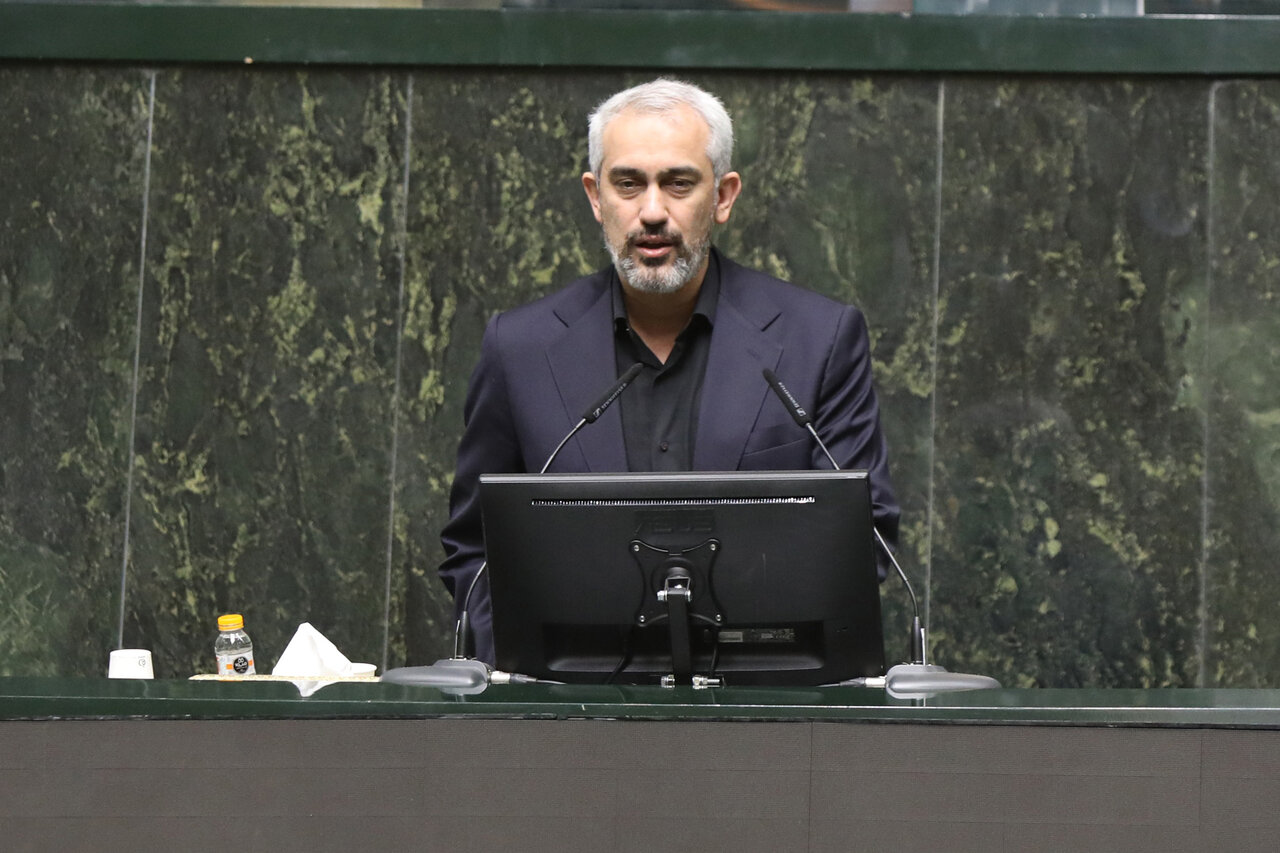
Iran’s economy minister told parliament on Tuesday that liquidity growth is slowing and monthly inflation has fallen for four consecutive months, as he sought to reassure lawmakers that the government is tracking the pressure high prices place on households, retirees and workers.
Seyed Ali Madanizadeh, answering questions from MPs, said he was not denying the hardship people face and that neither he nor the Ministry of Economy was avoiding responsibility. He described parliamentary scrutiny as legitimate and said open debate over economic problems reflected the country’s governance system.
The minister said he inherited a difficult situation when he took office about 18 months ago, describing it as an economic-war environment in which imbalances and structural crises had converged. The ministry set up an “economic war operations room,” he said, with early work focused on insolvent banks. He said the Bank Ayandeh case was handled successfully, while other troubled banks and financial institutions are now being processed by the Ministry of Economy and the Central Bank.
Madanizadeh said bank balance sheets are central to inflation control and that liquidity growth has taken a declining path, with its inflationary effects expected to become visible. He pointed to the capital market as an alternative source of non-inflationary financing, saying the stock index rose from about 3 million to more than 8 million units. He also cited reforms to the government bond market after eight years, saying realistic rates had reduced rent-seeking and the government’s reliance on the monetary base.
On the budget, he said the government tried to close the deficit with minimal spillover into the Central Bank’s monetary base. He said taxes now supply about 50 percent of public budget resources, tax revenues grew 39 percent last year and 70 percent growth is projected this year. He added that taxes on 10 million small businesses were zeroed out while large tax evaders became the focus.
The minister attributed price pressures largely to economic-war conditions, saying 230 million cubic meters of export gas and gas allocated to industries were damaged, and that petrochemical and steel facilities were hit. When foreign-currency sources are damaged and transport costs rise, he argued, exchange-rate pressure is natural. He rejected claims that the government deliberately removed preferential currency, saying it simply ran out.
Despite these pressures, he said monthly inflation has fallen below 4 percent, and described the goal as bringing inflation from above 90 percent to 40 percent and hopefully 20 percent next year. Iran’s economy, he insisted, has not collapsed and will not collapse.