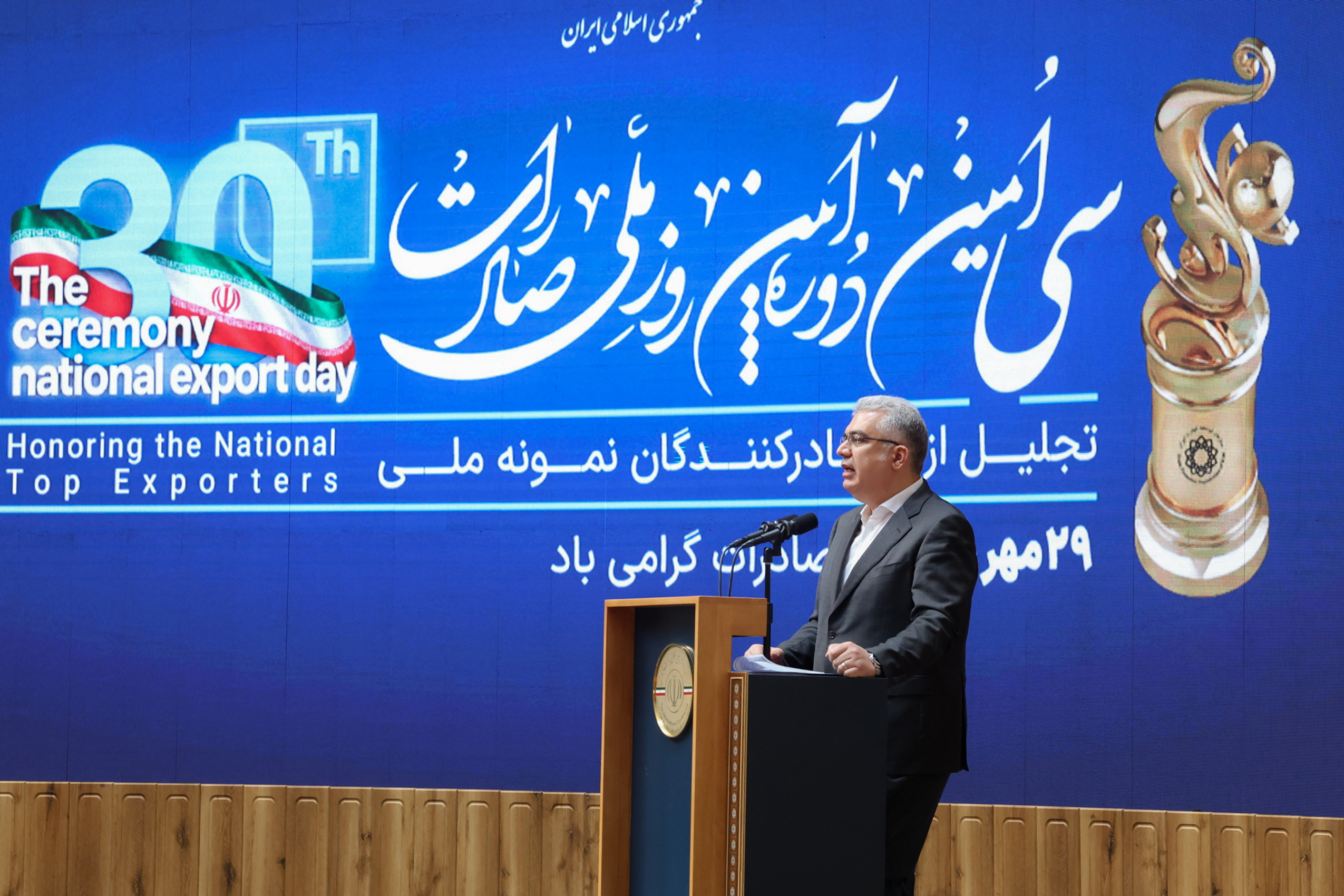
Iran’s 30th National Export Day, held Wednesday at the Summit Hall, brought together President Masoud Pezeshkian, Foreign Minister Abbas Araghchi, Minister of Industry, Mining and Trade Seyed Mohammad Atabak, Trade Promotion Organization (TPO) Head Mohammad Ali Dehghan Dehnavi, Iran Chamber of Commerce, Industries, Mines and Agriculture (ICCIMA) President Samad Hassanzadeh, and foreign-trade practitioners to honor the country’s exemplary exporters. The event also saw the unveiling of the Export Atlas system and recognition of 13 national premium companies and 43 national exemplary companies. Beyond the ceremony, the gathering served as a stocktaking exercise on war, sanctions, transport disruptions, foreign-exchange rules, and standards—issues that continue to shape Iran’s export performance.
Atabak Seeks Rapid-Response Committee on Export Obstacles
Atabak called for a joint committee comprising ICCIMA, his ministry, and the Central Bank to resolve exporters’ problems quickly. Noting that private-sector representatives sit on the Supreme Council for Non-Oil Exports, he said the multiplicity of government bodies there makes it necessary to form a specialized committee before issues reach the highest level. “Given hour-by-hour changes in the status of some borders, decisions must be made more quickly,” he said, addressing the President. Under his proposal, the committee would decide current exporter issues, while matters requiring higher-level approval would go to the Supreme Council. Atabak also said the newly unveiled atlas of official foreign-trade gateways should become a reference for traders, with continuous updating pursued by the TPO. He stressed the need to strengthen Iranian traders’ presence in target markets, including the Eurasian Economic Union, where officials said the number of active Iranian traders falls short of existing capacity. On standards, he said it was agreed to use the country’s prevailing standards and certificates of origin to prevent export stoppages.
TPO Pitches 10 Proposals as Transport Costs Bite
Dehghan Dehnavi said National Export Day is not about reciting figures but about appreciating those who sustain the link between domestic producers and foreign customers. He praised exporters for continuing trade under war, sanctions, and economic blockade, including problems in transferring funds, and for remaining committed to obligations and employment. Referring to the slogan “Dynamic Trade, Value-Creating Exports,” he said it is a performance criterion, not a mere title. He noted that 75 percent of Iran’s foreign trade had been conducted via sea, but alternative routes were redefined with help from various agencies, especially the private sector. He said Iran has the capabilities, knowledge, skills, and specialized manpower to raise trade from $1 billion a week to $1 billion a day. Calling exporters the front line of the economic war, he said domestic barriers must be removed and regulations facilitated. With transport costs rising, he pointed to appropriate incentives as one way to compensate, and announced 10 proposals aimed at entering the decision-making cycle to speed up problem-solving and remove export barriers.
ICCIMA: External Pressure Demands Coherent National Response
Hassanzadeh praised exporters for keeping trade flowing despite difficult economic and wartime conditions, calling protection of exports a strategic necessity for employment, foreign-exchange earnings, and economic credibility. He said Iran remains in a “neither war, nor peace” situation marked by uncertainty, economic pressure, trade restrictions, and threats to transport routes, with the enemy seeking to weaken Iran’s competitiveness by raising transaction costs. The response, he argued, must be a unified message from officials and the private sector: turn external pressure into a coherent will to keep trade flowing, remove domestic barriers, and neutralize costs through rationality, pragmatism, and national-interest-based decisions.
He called for moving from day-to-day crisis management to sustainable trade mechanisms and redefining export’s place in macro-economic policy, with coordination among foreign-exchange, industrial, financial, and trade policies. He proposed a Foreign Trade Continuity Headquarters involving the government, private sector, customs, and the Central Bank, and urged diversified transport routes, easier customs and border procedures, stronger trade insurance and risk management, and better inter-agency coordination. On forex, he sought alignment of repatriation and working-capital mechanisms with trade realities, review of restrictive business-card procedures, distinction between intentional violations and recoverable obligations, proportionate time to meet commitments, and no punitive measures against reputable exporters. Preserving markets, he said, requires attention to costs, payment terms, tariffs, and freight; without support, Iranian exporters cannot compete, and lost markets are hard to regain. He urged operational economic diplomacy, tariff and transport follow-ups, customs fixes, and neighbor cooperation, plus a shift to sustainable market presence through value added, quality, completed production chains, and stronger brands, while supporting downstream industries, technical and engineering services, knowledge-based products, and service exports.