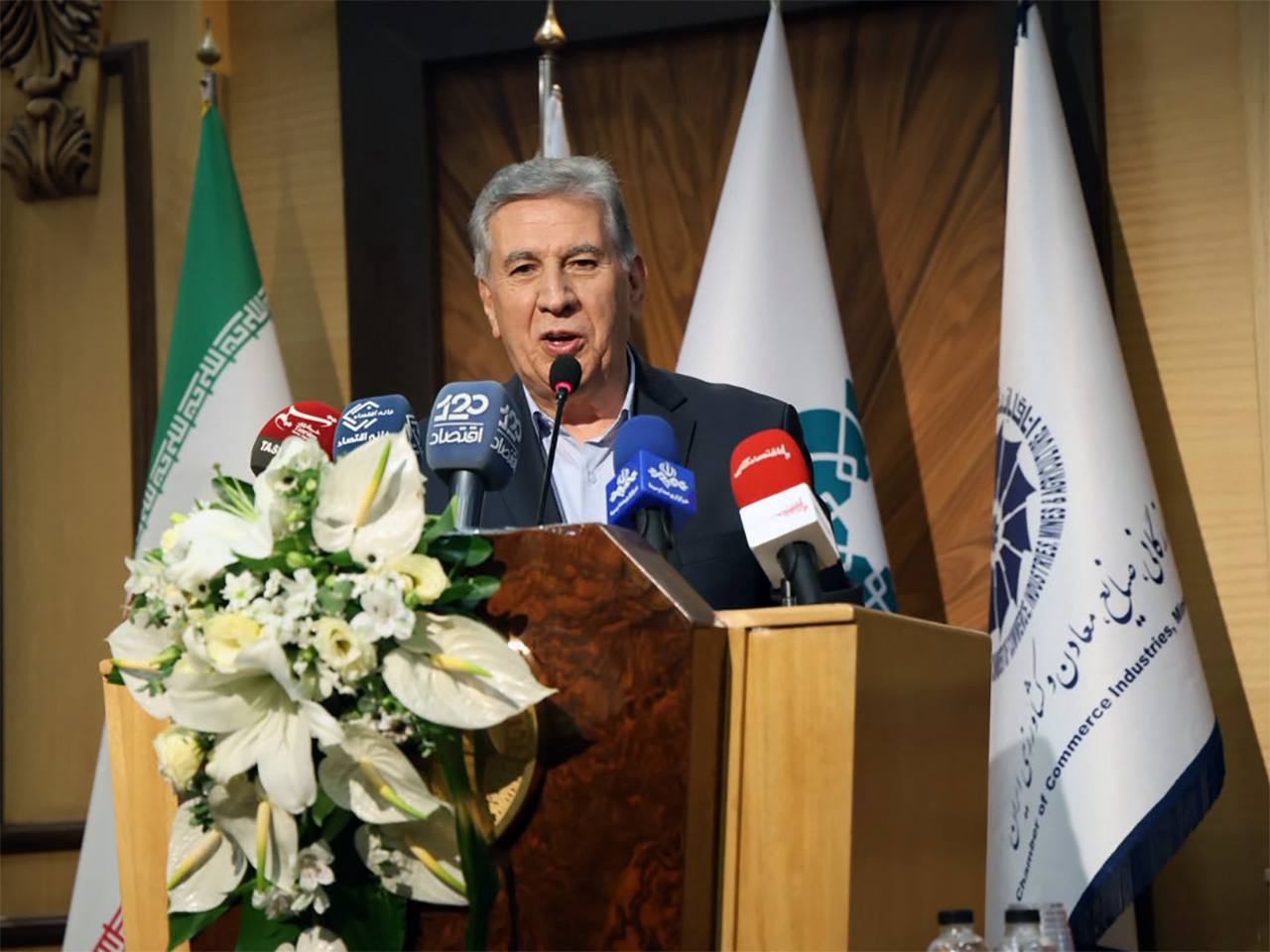
At the National Export Associations Conference in Tehran, held under the slogan “Capable Exporter, Strong Association, Sustainable Exports,” Iran Chamber of Commerce President Samad Hassanzadeh said foreign trade cannot be judged only by import-export statistics, trade balance or currency earnings. It is tied to production, employment, investment, economic security, technology access and Iran’s place in the regional and global division of labor. Under sanctions and maritime restrictions, he argued, protecting exports requires operational measures, regulatory reform and private-sector participation.
Transport tops the list. Hassanzadeh called for reducing dependence on limited routes by assessing northern ports, railways, land borders and regional corridors and designing alternatives by commodity, so disruption on one route does not halt exports or raw-material supply. He proposed a Foreign Trade Continuity Task Force involving the government, ICCIMA, Customs, the Central Bank, the Ports Organization and export associations. Customs and border procedures should be eased through electronic document exchange, coordinated border hours, pre-arrival processing and fewer repeated inspections, because delays and unnecessary stops impose double damage.
Financing and risk management are equally urgent. He urged working capital matched to real export cycles, faster repayment of claims and flexible foreign-exchange repatriation that reflects market differences and real transfer limits. He also called for insurance coverage, credit guarantees and risk-management tools suited to riskier routes. Markets must diversify: Iraq, once Iran’s largest partner, may see Iranian exports fall to a minimum next year as zero-tariff trade and six-month to one-year LCs from India, China and Turkey make Iranian prices uncompetitive. Economic diplomacy, he said, should focus on transit, customs coordination, transport agreements and legal access to international markets.
Trade Promotion Organization head Mohammad Ali Dehghan Dehnavi said regulatory reform cannot be carried out by one body; legislators, regulators and the private sector must participate. Some flexibility has been introduced since last summer, including direct exporter-importer agreements for second-group goods, but reports persist of exporters quitting or facing legal cases. The TPO welcomes export consortia, trade centers in target markets, trade delegations and proposals on foreign-exchange obligations.
He said non-oil exports reached $58 billion in 1403 and $52 billion in 1404 despite the Shahid Rajaee port incident and the 12-day war. With 75% of trade by weight moving by sea, volume fell 30-35% while value fell about 20%, suggesting higher-value goods still moved. Average export value is only $300-400 per ton, so Iran must process more before export and retain value-chain gains at home. Hassanzadeh said the state should focus on macro policy, transparent regulation, infrastructure and fair competition, while the private sector handles investment, productivity, innovation and jobs. He also stressed systematic collection of problems, expert solutions, periodic reports and follow-up to implementation to turn firms’ experience into effective decisions and increase trade resilience. The private sector, he added, is neither a substitute for sovereign duties nor able alone to bear all economic problems; government needs producers, exporters and investors to design and implement effective policies. The immediate priority, he said, is keeping firms operating and protecting household employment.