
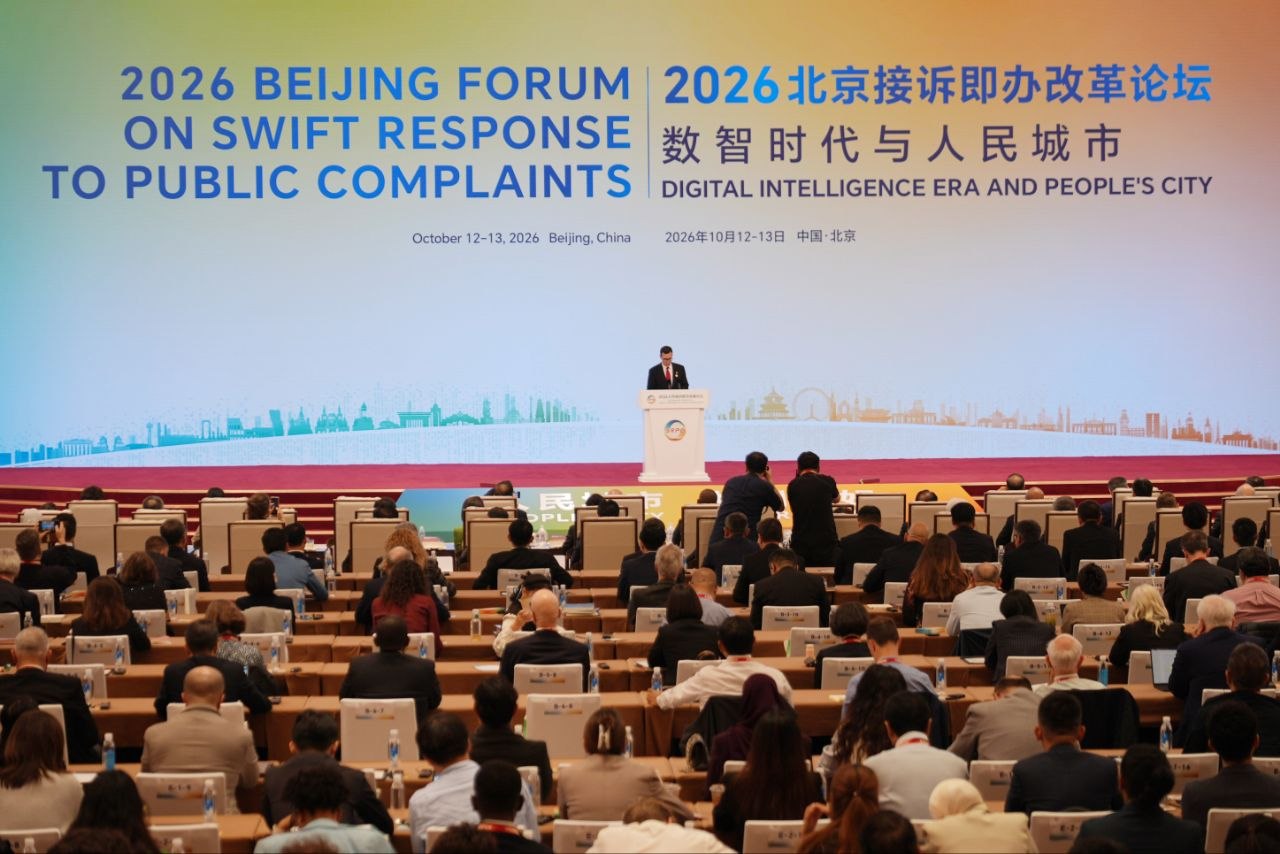
More than 3,200 participants from over 70 countries and regions gathered in Beijing for the 2026 Beijing Forum on Swift Response to Public Complaints in mid-October, a landmark event that highlighted how digital technology, citizen engagement, and responsive public services are transforming urban governance in the world's rapidly growing cities.
Held under the theme "Digital Intelligence Era and People's City," the forum brought together policymakers, scholars, urban planners, and international experts to exchange ideas on making cities more efficient, inclusive, and responsive to citizens' needs. Against a backdrop of accelerating urbanization and increasingly complex governance challenges, the event emphasized the importance of leveraging technology to build people-centered cities.
At the heart of the discussions was Beijing's celebrated 12345 citizen service hotline, a platform that has become one of China's most notable innovations in urban governance.
Since the launch of the "Swift Response to Public Complaints" reform initiative in 2019, the 12345 hotline has served as the primary channel through which residents and businesses can report problems, seek assistance, and communicate directly with city authorities. What sets the system apart is not merely its ability to receive complaints, but its capacity to ensure that issues are tracked, addressed, and resolved through a comprehensive closed-loop management mechanism.
The scale of the platform is remarkable. Over the past seven years, Beijing's 12345 system has processed around 200 million requests, inquiries, and complaints, while achieving both a resolution rate and citizen satisfaction rate exceeding 97%. These figures have positioned the hotline as a leading example of how public feedback can be translated into practical governance improvements.
Forum participants were particularly interested in how the system combines advanced digital tools with human-centered governance. Artificial intelligence, big data analytics, and intelligent operational platforms enable authorities to identify recurring problems, detect emerging trends, and address root causes rather than merely reacting to individual complaints. By analyzing massive volumes of citizen feedback, city managers can identify weaknesses in public services, optimize resource allocation, and improve decision-making.
The forum's various panels explored themes such as refined governance, digital empowerment, public participation, collaborative decision-making, and sustainable urban development. Site visits to the Beijing Municipal Citizen Service Hotline Center gave international delegates a first-hand look at how hotline operators, digital platforms, and government departments coordinate to respond quickly to citizens' concerns.
For many attendees, the significance of the 12345 model lies in its philosophy as much as its technology. The system embodies the principle that modern cities should listen closely to residents, treat public feedback as valuable governance data, and continuously adapt services based on people's real-life experiences. In doing so, Beijing has demonstrated a practical method for making governance more responsive, transparent, and efficient.
Lessons for Iranian Cities
As cities around the world search for ways to manage growing populations and increasingly complex urban challenges, the Beijing experience is attracting international attention. The forum reinforced the idea that effective governance today requires not only digital infrastructure but also institutional mechanisms that ensure every citizen's voice can influence policy and service delivery.
For cities such as Tehran, as well as other major Iranian metropolitan areas including Mashhad, Isfahan, Shiraz, and Tabriz, Beijing's 12345 hotline offers valuable lessons. A unified citizen-service platform capable of collecting complaints, coordinating responses across government agencies, and analyzing public needs in real time could significantly improve municipal services and resident satisfaction. Adapting elements of the Beijing model to local conditions could help Iranian cities strengthen accountability, accelerate service delivery, and move toward a smarter, more citizen-centered approach to urban governance.
Ultimately, the Beijing forum demonstrated that the future of successful cities may depend on a simple but powerful idea: listening carefully to citizens and responding effectively to their needs.