
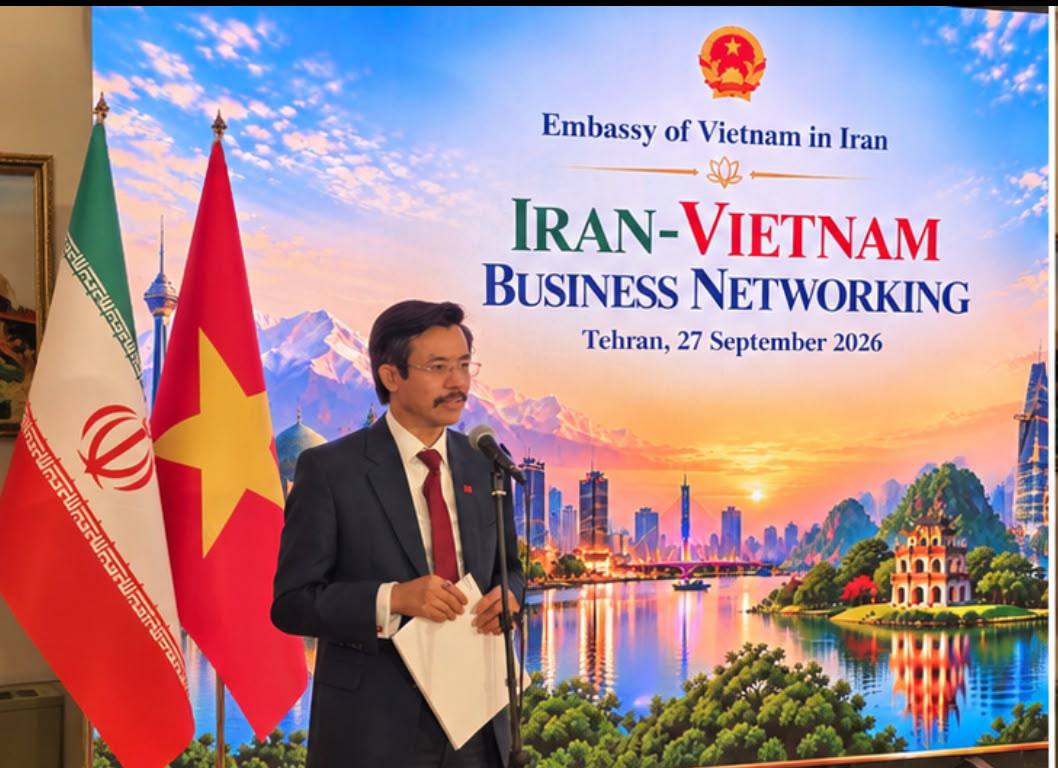
When Ghadir Qiafeh visited Vietnam years ago, he saw a nation that had "risen like a phoenix from the ashes of war." On September 27, the vice chairman of the Iran Chamber of Commerce, Industries, Mines and Agriculture (ICCIMA) brought that image to a Tehran gathering of more than 50 Iranian and Vietnamese businessmen, urging them to turn admiration into action.
The Vietnam–Iran Business Networking Event, hosted at the Vietnamese Embassy in Tehran, was as much a reality check as a celebration. Vietnam's eight-month trade has reached $770 billion, Qiafeh noted — a figure he called "very big for a South Asian country." Yet direct trade with Iran stands at just $170 million, of which $150 million is Vietnamese exports and only $20 million Iranian exports.
"Despite the economic capabilities of Iran and Vietnam, bilateral trade remains very low," Qiafeh said, calling for a "noticeable leap" in economic relations. Cooperation must be win-win, he stressed, with both sides playing a role in Asia's value chain.
Opening remarks framed Vietnam not merely as a market but as a strategic platform — a bridge between Iranian businesses and ASEAN, and a gateway for Vietnamese firms into Iran and the wider region. Vietnam's trade combines manufacturing strength with competitive agriculture and food processing, creating complementarity: Vietnamese goods for Iran; Iranian raw materials, petrochemicals, agricultural products and other goods for Vietnam.
Ambassador Nguyen Luong Ngoc used his address to lay out both the promise and the obstacles. Vietnam's GDP grew 8.02% in 2025, reaching approximately $514 billion, with GDP per capita exceeding $5,000. Merchandise trade hit roughly $930 billion, marking ten consecutive years of trade surplus, supported by 17 free trade agreements giving preferential access to 60 economies. Registered foreign investment reached $38.4 billion, and 21.2 million international visitors arrived last year.
"Viet Nam is not only a market of more than 100 million people, but is also continuing to strengthen its position as a manufacturing and export hub," the ambassador said.
Agriculture remains a key strength, with Vietnam among the world's leading exporters of coffee, pepper, cashew nuts, rice, tea, seafood, fruits and vegetables. Coffee drew particular attention. Vietnam is the world's second-largest coffee producer and exporter, with a strong position in Robusta. Iranian demand for coffee is growing, and the ambassador suggested cooperation could extend beyond raw beans into roasting, packaging, branding and distribution tailored to Iranian tastes.
Yet the ambassador was candid about the hurdles. Payment remains "one of the greatest obstacles," with no direct banking channels making transactions complicated and costly. Transportation and logistics have been hit by regional developments affecting shipping routes and delivery times. Technical requirements — standards, quarantine, labelling, product registration — need clearer information to avoid delays and extra costs. Commercial risks and partner verification are further concerns.
"These are not issues that can be resolved through a single meeting," Ambassador Ngoc said. "However, we can certainly address them step by step."
He proposed a focused, results-oriented business mission to Vietnam with pre-arranged B2B meetings, meetings with the Vietnam Chamber of Commerce and Industry (VCCI) and Iran's embassy in Hanoi, cooperation with Vietnam Persian Market, and visits to Cai Lan port in the Ha Long area and Ho Chi Minh City. Regional connectivity, he stressed, matters as much as individual markets.
The embassy, he said, will continue connecting businesses with genuine commercial needs, helping verify suppliers and partners, promoting information exchange on regulations and logistics, and encouraging the shift from one-off transactions to stable, long-term supply relationships.
"Concrete results" — a successfully delivered container of coffee, a safely completed pepper contract, a reliable supplier found — are the foundation for sustainable trade, he said.
Qiafeh echoed the call for practical steps, pointing to transportation and logistics as critical and urging the creation of a database for traders. He called for stronger ties between ICCIMA and VCCI.
Meysam Sadri of the Iran–Vietnam Friendship Association noted the group has been active for over 25 years, with offices in Hanoi and Ho Chi Minh City. After 15 years of follow-up, he said, it finally achieved the establishment of a direct flight between the two countries — a development that could boost tourism, trade and people-to-people exchanges.
Following the speeches, businessmen engaged in a question-and-answer session before a dinner where they had the chance to build the direct contacts both sides say are essential.