
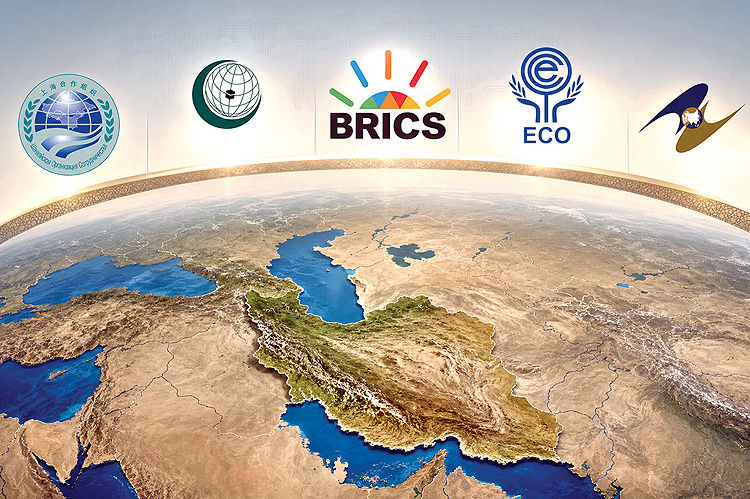
Iran’s membership in regional and international economic groupings has expanded its commercial connections, but the country has yet to turn these memberships into reliable protection against sanctions, war-related disruptions and trade costs.
Experts say the Eurasian Economic Union, BRICS, the Shanghai Cooperation Organization, the Economic Cooperation Organization and the Organization of Islamic Cooperation offer different opportunities. Yet banking restrictions, weak logistics, disrupted transport corridors and domestic barriers continue to limit their impact on Iran’s foreign trade.
Among Iran’s regional arrangements, the Eurasian Economic Union appears to have delivered the clearest commercial results. Iran’s free trade agreement with the bloc and its five member states took effect on May 15, 2025.
Mohammad-Sadegh Qanadzadeh, deputy head of the Trade Promotion Organization of Iran, said the agreement represents Iran’s first multilateral free trade deal since the establishment of the Islamic Republic.
He said trade between Iran and Eurasian members had increased more than 2.5 times from the temporary agreement until roughly two years ago. Since the free trade agreement took effect, bilateral trade has grown by about 20% to 30% annually, and in some cases by as much as 40%, he said.
“This experience shows that regional agreements can have a real impact on foreign trade when the necessary conditions are provided,” Qanadzadeh said.
BRICS has a much larger economic footprint than the Eurasian bloc, but it is neither a customs union nor a free trade area. The Shanghai Cooperation Organization is primarily a framework for political, security and economic cooperation, while the ECO offers potential for regional trade and transit.
Banks and Corridors
However, membership alone cannot overcome the structural obstacles facing Iranian trade.
Qanadzadeh identified sanctions as one of the main barriers, saying some countries remain cautious because of political considerations and their own exposure to sanctions. He also pointed to incomplete banking, financial and logistics infrastructure.
“Part of our financial and banking connections and logistics infrastructure has not yet been fully established,” he said, adding that Iran has not created all the domestic capabilities needed to use the agreements effectively.
He said Iran is working to address weaknesses in logistics, infrastructure, standards and customs, while BRICS and other organizations provide opportunities for cooperation in payments, technology and trade.
Mohammadreza Modoudi, a trade expert, said banking remains a more fundamental problem than membership in any particular organization. “As long as Iran’s banking relations with the global financial network are not restored, the country’s foreign trade will inevitably remain affected by this limitation,” he said.
Modoudi argued that sanctions have made foreign companies more cautious because they fear exposure to penalties. At the same time, war has created new risks by disrupting major trade routes.
He said Iran’s dependence on maritime trade has exposed the country to concentrated risks. More than 80% of Iran’s foreign trade has been dependent on maritime activity, he said, while northern maritime trade remains much smaller than southern trade.
Current disruption, Modoudi argued, highlights the need to strengthen land borders and neighboring markets. Iran has extensive land borders with several countries, but has not created sufficient facilities and procedures to use them effectively.
Long truck queues at border crossings illustrate the problem, he said. Domestic agencies are still operating under rules designed for normal conditions, while wartime trade requires faster and flexible procedures.
Modoudi said land routes could help compensate for maritime disruptions, but slow border procedures are preventing that shift. Delays increase trade costs and reduce Iran’s ability to use neighboring countries as alternative corridors.
Still, he said opportunities remain. Some foreign companies may continue working with Iran if commercial benefits outweigh risks, while some countries may seek to preserve or expand trade through informal arrangements.
The challenge, he said, is the absence of a clear plan for capturing these opportunities.
Both experts point to the same broader issue: regional agreements can open doors, but they cannot replace domestic reforms. Iran’s ability to benefit from BRICS, Eurasia and other regional frameworks will depend on stronger banking channels, better logistics, more efficient customs procedures and diversified transport corridors. Without those changes, the agreements may expand diplomatic ties without delivering their full potential for Iranian trade.