No city should have to rely on the next construction boom to finance essential public services. Yet this has long been the financial reality for many Iranian municipalities.
For decades, municipal finance in Iran has relied heavily on construction-related revenues. During periods of rapid real estate development, building permits and development charges strengthen municipal budgets. When the property market slows, however, municipal revenues decline while municipal responsibilities remain unchanged. Roads still require maintenance, public transportation must continue operating, waste collection cannot be interrupted, and cities must keep investing in essential infrastructure regardless of economic conditions.
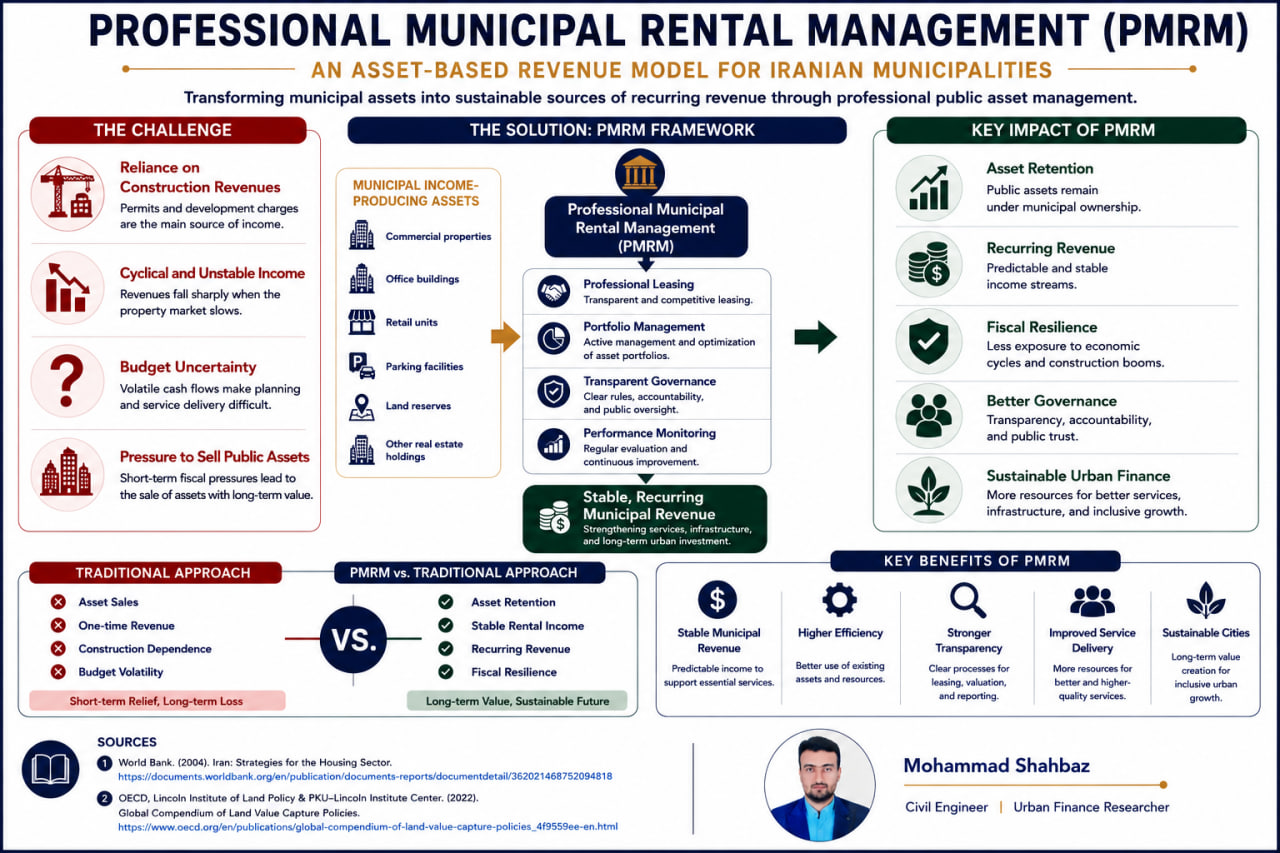
This is not merely a cyclical budget problem; it is a structural weakness in municipal finance. According to the World Bank, land- and building-related revenues historically accounted for nearly half of municipal revenues and more than 60 percent of municipalities' own-source revenues in Iran. Although these figures relate to an earlier period, they illustrate a challenge that remains familiar today: excessive dependence on construction leaves municipalities financially exposed whenever the property market weakens.
The debate, therefore, should move beyond searching for new revenue sources. A more fundamental question deserves attention: How can municipalities create greater value from the public assets they already own?
Across Iran, municipalities own extensive portfolios of commercial buildings, office space, retail units, parking facilities, land reserves, and other valuable real estate accumulated through decades of urban development. Many of these assets enter municipal ownership through development agreements, negotiated settlements, land exchanges, legal transfers, and other statutory mechanisms. Yet too often they remain underutilized or are sold to relieve short-term fiscal pressures.
A more sustainable alternative is Professional Municipal Rental Management (PMRM), a framework for managing income-producing municipal assets as professionally operated rental portfolios that generate recurring revenue while preserving public ownership.
Rather than disposing of commercially viable properties, municipalities can lease and manage appropriate assets through transparent, competitive, and professionally administered mechanisms. Rental income becomes a stable complement to construction-related revenues, while the assets themselves remain long-term public capital.
PMRM is more than a property management strategy. It represents a different philosophy of municipal finance—one that replaces dependence on one-time asset sales and cyclical construction revenues with the productive stewardship of public wealth. Municipal finance should be built not on the repeated sale of public assets, but on their long-term productivity.
The distinction is fundamental. Selling a municipal asset may improve a budget in the short term, but it permanently eliminates the future income that asset could generate. PMRM follows a different financial logic: public assets remain on the municipality's balance sheet while continuously producing recurring revenues that support public services, infrastructure maintenance, and long-term urban investment.
Beyond financial returns, PMRM also promotes better governance. Professional rental portfolios require reliable asset inventories, transparent leasing procedures, regular valuation, performance monitoring, and clear public accountability. These practices improve financial discipline and enable municipalities to make long-term decisions based on the productive use of public assets rather than short-term fiscal pressures.
International experience reinforces this approach. The OECD has identified strategic public land and asset management as an important component of sustainable urban finance, while the World Bank has highlighted the fiscal risks associated with excessive dependence on construction-related revenues. Although institutional arrangements differ across countries, the underlying principle is consistent: financially resilient municipalities diversify their revenue base and manage public assets strategically.
PMRM is not intended to replace construction-related revenues. Construction will remain an essential driver of urban growth and local investment. The objective is to complement cyclical construction income with stable, recurring rental revenues generated from professionally managed municipal assets, creating a more balanced and resilient municipal finance system.
For Iranian municipalities, PMRM represents more than a new revenue source. It represents a shift in perspective—from viewing public property as an asset to be sold toward managing it as productive public capital capable of creating lasting economic value.
Cities do not become financially resilient by selling public assets. They become financially resilient by transforming public assets into long-term public value through PMRM.