
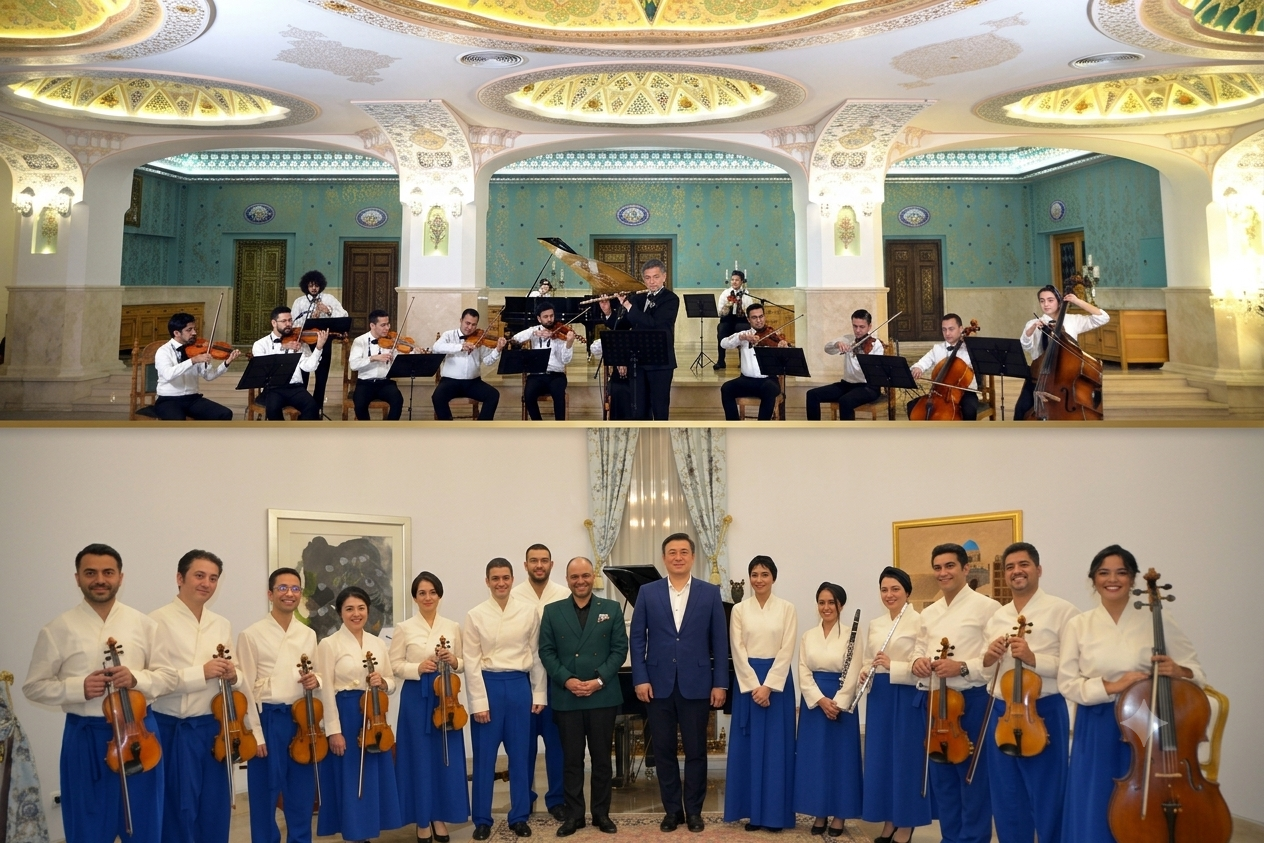
Dr. Mahdi Norouzi is the founder and director of ISTGAH, an International Cultural Relations Strategist, and a Cultural Project Designer and Director. He began his professional journey in music, but his work gradually moved beyond the stage and developed into the design of intercultural collaborations between Iran and other countries.
ISTGAH’s collaborations with the embassies and cultural institutions of South Korea, Japan, Italy, the Philippines, Austria, and Mexico, alongside projects presenting and reinterpreting Iranian cultural heritage for international audiences, have shaped an important part of this path.
In this interview, Norouzi discusses the Iranian roots of his approach, the design of cultural trust, the role of media, and the international and economic future of ISTGAH.
⸻
1. How do you define your international work?
I define my work through international cultural relations, intercultural experience design, and the management of multidisciplinary cultural projects.
Music was the starting point of my professional journey and remains one of my primary working languages. However, my work today is not limited to music or orchestra management. Depending on the nature of each project, we may work with music, visual art, photography, cinema, fashion and apparel design, architecture and spatial design, food, ritual traditions, literature, and media.
I do not see these as separate services. They are different languages within a single cultural experience. Fashion can communicate the history, identity, climate, and craftsmanship of a society. Architecture is not merely a background for an event; space shapes how audiences enter, move through, and remember an experience.
My work begins with research and continues through concept development, partnership design, project delivery, media storytelling, documentation, and the development of future collaboration.
As an Iranian cultural designer, I feel responsible for bringing Iran into dialogue with the world with accuracy, dignity, and its full cultural complexity.
⸻
2. How does being Iranian shape your approach?
Being Iranian is not simply a geographical label or a collection of decorative symbols. It is the foundation of my perspective.
I come from a culture in which music, poetry, architecture, hospitality, storytelling, and the relationship between art and everyday life have deep historical roots. Iran has also long been a place of cultural movement, exchange, and encounter.
For this reason, I do not see Iran as a closed culture or one that belongs only to the past. To me, Iran is living, diverse, deeply rooted, and contemporary.
My goal is not to represent Iran only through familiar images such as carpets, historical monuments, or traditional music. These elements are valuable, but they do not represent the whole country.
I want to show that Iranian culture still has the power to create, to enter meaningful dialogue, and to participate in shaping the future.
⸻
3. What is the difference between an international event and an international cultural relationship?
The presence of several flags or foreign guests does not automatically make an event genuinely international.
An event may take place in one evening and end there. A cultural relationship begins when both sides learn about one another, participate in the design process, create a shared experience, and have a reason to continue working together after the event.
For me, international quality is not defined by the number of countries involved. It is defined by the quality of the relationship between them.
When one side simply presents its culture while the other remains a spectator, we are dealing with a cultural presentation. Intercultural dialogue begins when both sides contribute part of their identity, creativity, and responsibility to the project.
⸻
4. How did the collaboration with the Embassy of South Korea become a key example of this approach?
Our aim was not simply to place Iranian and Korean music within the same program. We wanted to create a form of participation that felt genuine and meaningful to Iranian audiences.
The South Korean Ambassador’s performances of Porsoon Porsoon and later Jan-e Maryam were important not only because these songs are widely loved in Iran. Their deeper value came from the fact that a foreign diplomat invested time in learning Persian and respectfully entered the cultural memory of the host society.
Iranian culture was not a decorative background to the event. It was at the center of the relationship.
For me, the most important outcome was not limited to media attention or a positive public reaction. The first collaboration created greater trust and led to further projects. That continuity demonstrated how a successful performance can become cultural capital for a future relationship.
⸻
5. How do you select a cultural work or symbol for these projects?
Selecting a cultural work is both an artistic and a strategic decision.
It should hold a genuine place in public memory, suit the occasion and its formal context, be accessible to the international participant, and allow for a professional reinterpretation.
At the same time, we must avoid reducing cultures to simplified images. Japan is more than Mount Fuji and cherry blossoms, just as Iran is more than carpets and classical poetry.
A symbol can become the starting point of a relationship, but it should never replace the entire cultural narrative. Our responsibility is to understand the history, people, meaning, and human experience behind it.
Respect for culture begins with research, not with poster design.
⸻
6. How does the collaboration with Japan differ from the Korean experience?
Every cultural relationship needs its own language and logic.
ISTGAH’s relationship with Japan has developed over several years, beginning with performances connected to the Emperor’s Birthday and collaborations with Japanese artists. The next stage focuses on developing a deeper musical and visual experience based on shared memory, orchestral reinterpretation, and Japanese cultural narratives.
In the Korean projects, the Ambassador’s direct participation and performances of Iranian songs played a central role. In the Japanese project, musical subtlety, visual storytelling, and the cultural memory shared by different generations become more significant.
We do not intend to repeat one successful formula across different countries. Every society and every cultural partner deserves a project designed around its own identity.
A shared cultural point must be discovered, not imposed in advance.
⸻
7. What do the projects with the Philippines, Italy, Austria, and Mexico reveal about ISTGAH’s wider work?
They demonstrate that ISTGAH’s work extends beyond musical performance.
In the Philippine collaborations, music was connected with traditional clothing, fashion, visual storytelling, food, and cultural content production. In the Austrian project, children, music, movement, painting, collaboration, and equality were brought together.
In the Mexican project, music was designed in relation to photography and exhibition space, allowing sound to become part of the audience’s visual experience. The Italian collaboration also demonstrated how quality, respect, and precise delivery can transform an initial initiative into a lasting relationship.
These experiences clarify our approach:
We do not simply organise cultural programmes. We design experiences in which cultures can genuinely relate to one another.
⸻
8. What role does media play in building your international credibility?
For us, media is not only a means of visibility. It is part of the project’s credibility architecture.
Credible media coverage can transform an achievement from a personal claim into a public, searchable, and verifiable record.
It creates four forms of credibility.
First, personal credibility, because my role as a project designer and director is documented by an independent source.
Second, institutional credibility for ISTGAH, because future partners can examine our experience and the quality of our collaborations.
Third, cultural credibility for Iran, because it demonstrates that Iran is not merely the host or subject of an international project. It also contributes ideas, artists, management, and production capacity.
Fourth, commercial credibility, because official documentation and trusted media coverage reduce the perceived risk for embassies, brands, and sponsors.
Our goal is not simply to increase the number of published articles. It is to build a coherent public record that accurately documents the project, ISTGAH’s role, its outcomes, and the collaboration that followed.
⸻
9. What does a sustainable cultural economy mean to you?
Culture becomes sustainable when it has a clear economic model alongside its artistic and social value.
Cultural projects should not always depend on short-term support, emergency funding, or the permanent sacrifice of artists.
Within an international project, research, concept development, artist selection, arrangement, production, spatial design, relationship management, media, documentation, and intellectual property are all specialized and value-creating activities.
ISTGAH’s future model can be built on annual partnerships with cultural institutions, project design for embassies, responsible brand collaborations, content production and distribution, licensing, and selected private cultural experiences.
My goal is not to commercialize Iranian culture superficially. It is to ensure that cultural value can generate income, employment, continuity, and international opportunities for Iranian artists and professionals.
⸻
10. How do you measure the success of an international project, and how do you see ISTGAH’s future?
Success cannot be measured only through guest numbers, views, or media coverage.
I consider whether the project achieved artistic precision, represented each culture respectfully, created genuine participation, credited its artists properly, and produced a lasting content or intellectual asset.
However, continuity remains my most important measure:
Did the first project lead to trust, a second invitation, or a deeper collaboration?
My vision is for ISTGAH to become an independent Iranian platform for designing and developing international cultural relationships, working from research and concept development through production, media, impact measurement, and long-term partnership building.
I come from Iran, from a culture that has used art for centuries to understand humanity, preserve memory, and create connection.
My mission is to translate this historical and human capital into the language of the present, not to present a decorative image of Iran, but to build real, equal, and sustainable relationships with the world.
To me, Iran is not a past to be displayed. It is a living force with which to help shape the future.