
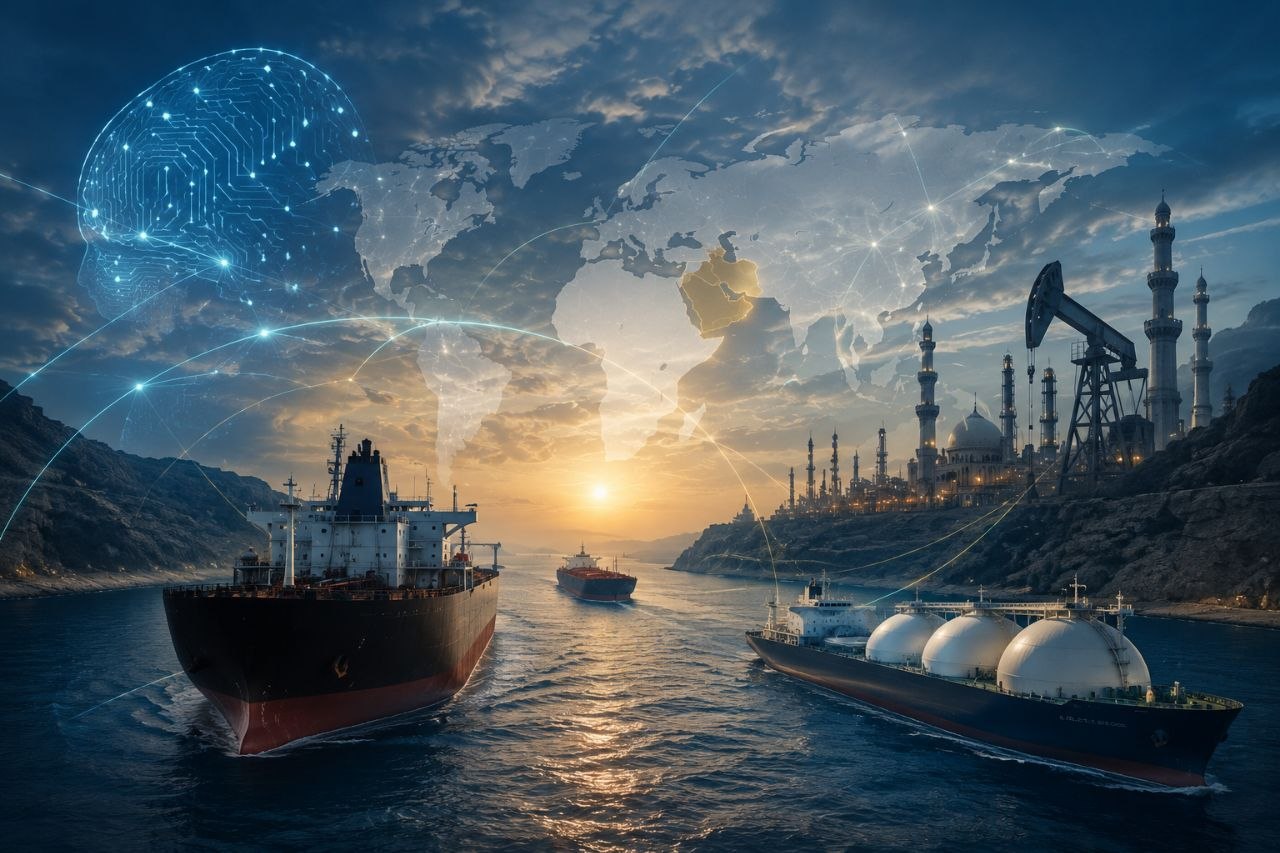
For decades, the Middle East has been defined by one strategic reality: energy flows determine geopolitical influence. Today, however, the region is entering a new phase in which energy security is no longer determined solely by production capacity. Instead, the resilience of maritime corridors, digital infrastructure, artificial intelligence, and geopolitical stability has become equally decisive. Recent tensions surrounding the Strait of Hormuz and the Bab el-Mandeb Strait demonstrate that the global energy system is increasingly vulnerable—not because the world is running out of hydrocarbons, but because the routes connecting producers to consumers have become strategic pressure points. The next chapter of global energy competition will therefore be shaped not only by oil reserves but also by data, logistics, technology and intelligent infrastructure.
The World’s Most Strategic Energy Crossroads
No other region carries comparable importance for international energy markets. The Middle East accounts for nearly half of the world's proven crude oil reserves and around 40% of proven natural gas reserves, making it the single most influential energy-producing region worldwide. More importantly, the region controls the world's most critical maritime energy corridors. Every day, roughly 20 million barrels of crude oil and petroleum products transit the Strait of Hormuz—representing nearly one-fifth of global oil consumption.
The Bab el-Mandeb Strait, linking the Red Sea to the Gulf of Aden and the Indian Ocean, carries approximately 8–9 million barrels of oil and petroleum products per day, alongside a substantial share of containerized trade between Asia and Europe.
Together, these two chokepoints influence energy prices far beyond the Middle East itself. Any disruption rapidly affects insurance costs, shipping rates, freight capacity and ultimately inflation across global markets.
Conflict Has Changed the Risk Equation
The geopolitical landscape has changed considerably over the past two years. Military confrontations in Gaza, attacks on commercial shipping in the Red Sea, regional exchanges involving Iran and Israel, and broader instability across the Levant have fundamentally altered investor perceptions of geopolitical risk.
Unlike previous regional crises that remained relatively localized, today's tensions directly intersect with international supply chains. Shipping companies have increasingly diverted vessels around the Cape of Good Hope, adding thousands of nautical miles to voyages between Europe and Asia. The consequences are measurable:
• Longer transportation times
• Higher fuel consumption
• Increased freight costs
• Rising insurance premiums
• Greater volatility in commodity markets
Even without a complete closure of strategic waterways, uncertainty itself has become an economic cost. Markets now price geopolitical risk almost continuously.
Oil Markets Are More Resilient—but Not Immune
Unlike previous decades, global oil markets possess greater flexibility. The United States has emerged as the world's largest oil producer, Brazil continues expanding offshore production, Guyana has become a major new exporter, and non-OPEC supply has grown steadily.
These developments reduce—but certainly do not eliminate—the strategic importance of the Middle East. Few alternative production regions could immediately compensate for a prolonged disruption affecting Hormuz.
Similarly, LNG markets remain heavily dependent on uninterrupted exports from Qatar, one of the world's largest liquefied natural gas suppliers. Consequently, even temporary interruptions could trigger sharp price movements across both oil and gas markets.
Artificial Intelligence Enters the Energy Equation
The next transformation goes beyond hydrocarbons. Artificial Intelligence is becoming a new layer of energy security.
Leading energy companies now deploy AI for predictive maintenance, pipeline monitoring, cyber-defense, refinery optimization, reservoir modeling, logistics management and real-time demand forecasting. Satellite imagery processed through AI enables governments and companies to monitor shipping traffic, identify operational anomalies and anticipate disruptions before they escalate. Digital twins allow operators to simulate refinery performance and optimize production under changing market conditions.
Machine learning models increasingly improve electricity demand forecasting, LNG scheduling and strategic inventory management. In other words, AI is no longer merely improving efficiency—it is becoming an instrument of national energy resilience.
The Digital Infrastructure Behind Energy Security
Future energy competition will depend as much on digital infrastructure as on physical infrastructure. Ports, pipelines, storage terminals and refineries are becoming data-intensive systems. Cybersecurity therefore becomes inseparable from energy security.
Recent cyberattacks against critical infrastructure around the world illustrate how digital vulnerabilities can interrupt physical energy flows. Protecting energy infrastructure now requires integrated investments in AI-driven monitoring, cloud computing, industrial automation and cyber resilience. Countries that neglect these capabilities may find themselves vulnerable even without conventional military conflict.
A Multipolar Energy Market
Another structural shift is reshaping global energy dynamics. The energy market is gradually becoming multipolar.
China has become the largest importer of Middle Eastern crude.
India continues expanding its energy demand.
Europe seeks supply diversification following the reduction of Russian imports.
Meanwhile, Persian Gulf producers increasingly balance commercial relations across Asia, Europe and North America rather than relying on a single geopolitical bloc. This diversification creates opportunities but also increases strategic complexity. Energy diplomacy is becoming more transactional and less ideological.
The Near-Term Outlook
Looking ahead over the next three to five years, several trends appear increasingly likely.
First, geopolitical tensions are expected to remain elevated rather than disappear. While major powers have strong incentives to prevent a prolonged closure of Hormuz or Bab el-Mandeb, intermittent disruptions, proxy conflicts and localized security incidents are likely to persist.
Second, investment in energy infrastructure will increasingly prioritize resilience over expansion. Governments and energy companies are expected to accelerate spending on strategic storage, redundant logistics networks, digital monitoring systems and cyber protection.
Third, Artificial Intelligence will become a standard component of energy operations rather than a competitive luxury. Companies capable of integrating predictive analytics, intelligent automation and real-time operational intelligence will enjoy measurable cost advantages and stronger resilience during crises.
Finally, the energy transition itself will not reduce the strategic significance of the Middle East in the near future. Although renewable energy continues to expand globally, hydrocarbons are expected to remain indispensable for transportation, petrochemicals, aviation and industrial production for decades.
The Strategic Question
The defining question for policymakers is no longer whether geopolitical instability influences energy markets. That relationship has become self-evident. The more important question is whether governments and industries can build resilient systems capable of operating under persistent uncertainty.
The future of global energy security will not be determined solely by oil fields or shipping lanes. It will increasingly depend on the integration of digital technologies, artificial intelligence, resilient infrastructure and strategic diplomacy. The Middle East remains the world's most important energy crossroads—but the nature of power is changing.
Tomorrow's energy leaders will be those capable of protecting not only the physical movement of oil and gas, but also the digital intelligence that now governs their production, transportation and distribution. In an era defined by geopolitical uncertainty, resilience—not merely production capacity—may become the most valuable energy asset of all.