
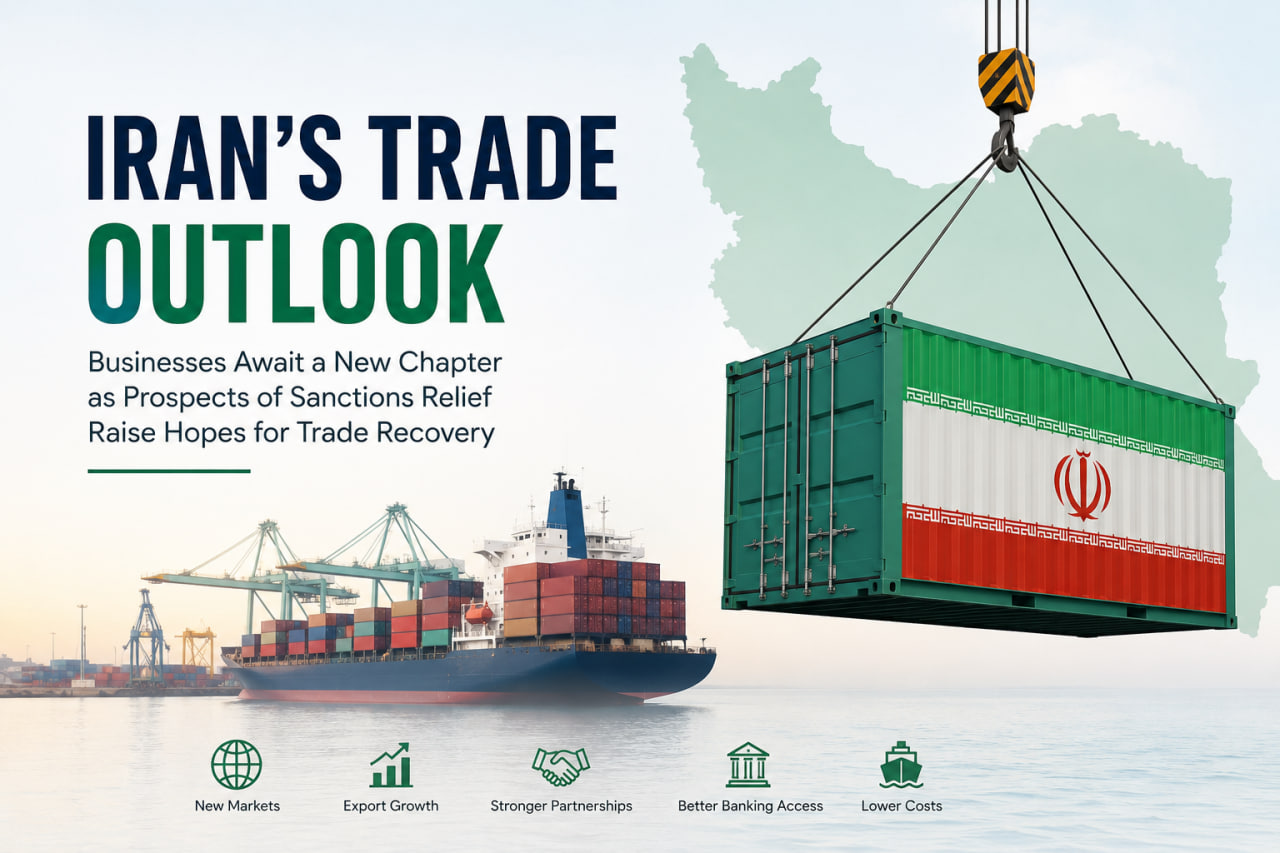
Iran’s foreign trade sector may be entering a new phase after Tehran and Washington announced overnight that they had reached an understanding aimed at ending the recent conflict, with a formal agreement expected to be signed in the coming days. Although the details have not yet been released, the announcement has fueled hopes among businesses that years of sanctions-related constraints and the disruptions caused by the recent war could gradually give way to a more stable commercial environment.
Over the past decade, Iranian traders have faced a combination of domestic and international obstacles. Alongside challenges such as foreign exchange restrictions, energy shortages, financing difficulties, aging transport infrastructure and limited banking connectivity, US-led sanctions have significantly increased the cost of doing business with the world. As a result, much of Iran’s trade has relied on indirect routes, intermediaries and costly financial arrangements.
The recent conflict added another layer of pressure. The closure of the Strait of Hormuz during the war disrupted one of Iran’s most important trade arteries, raising shipping costs, altering transport routes and increasing uncertainty across regional markets. Although the ceasefire has allowed some commercial activity to resume, the effects of the conflict continue to weigh on foreign trade.
Against this backdrop, the prospect of sanctions relief has revived a long-standing question: how much could Iran’s trade expand if restrictions on banking, payments and international commerce are eased?
Private-sector representatives argue that the answer depends largely on whether the upcoming agreement results in meaningful and lasting sanctions relief.
Two Stages of Recovery
According to business leaders, Iran’s trade recovery should be viewed in two phases. The first involves restoring commercial relations and trade routes damaged during the war. The second is a longer-term process centered on sanctions removal, financial reintegration and economic expansion.
“First, we need to restore trade and economic relations to the conditions that existed before the war,” said Keyvan Kashefi, a board member of the Iran Chamber of Commerce. He stressed that both government institutions and the private sector should work to repair commercial links with regional partners, including the United Arab Emirates and Saudi Arabia.
Kashefi noted that returning to pre-war conditions alone would not solve Iran’s structural trade challenges.
“The best outcome for Iran would be for the negotiations and understandings reached to ultimately lead to sanctions removal,” he said.
Even a gradual lifting of sanctions, he added, would represent a major economic turning point. According to Kashefi, reconnecting with international banks, reviewing existing regulations and reducing trade risks would help stimulate growth and lower costs across the economy.
“If sanctions are lifted, foreign trade risks will decline, exports will expand and many of the costs currently imposed on production and commerce will be reduced,” he said.
Kashefi argued that many of the restrictions governing Iran’s economy today are rooted in years of sanctions pressure. Stronger foreign exchange reserves following sanctions relief, he said, could also help policymakers address infrastructure bottlenecks and economic imbalances more effectively.
Export Potential
Exporters are particularly optimistic about the opportunities that could emerge from a post-sanctions environment.
Sadreddin Niavarani, vice chairman of the Export Commission at the Iran Chamber of Commerce, believes Iran could regain access to markets that were lost because of financial and banking restrictions.
“We have lived with US sanctions for more than four decades and European restrictions for many years,” he said. “The removal of these barriers could increase exports by 100% to 200%.”
According to Niavarani, Iran previously exported agricultural products, food items and petrochemicals to major destinations such as South Korea and several European countries. Many of these markets became inaccessible as sanctions complicated payment transfers and financial transactions.
“The reopening of these markets would create significant employment opportunities across the country,” he said.
Niavarani also expects sanctions relief to improve import quality and reduce costs by broadening Iran’s access to international suppliers.
The UAE’s Continued Importance
Despite expectations that Iran’s trade network could diversify after sanctions relief, business leaders believe the UAE will remain one of the country’s most important commercial partners.
Niavarani described the UAE as a long-standing and reliable trading partner that plays a unique regional role because of the strategic position of Jebel Ali Port.
“It is difficult to imagine another country replacing the role that the UAE currently plays in regional trade,” he said.
Rather than competing directly with Jebel Ali, he argued, Iran should focus on strengthening its own logistics infrastructure. Ports such as Bandar Abbas, Chabahar and Sirik require upgrades in cargo handling, customs services, warehousing and operational efficiency to take advantage of future trade opportunities.
Imports Could Normalize
Importers also see potential benefits from improved regional stability and sanctions relief.
Ahmadreza Farshchian, head of the Import Management Commission at the Iran Chamber of Commerce, said that the normalization of maritime routes would quickly improve trade flows.
“If the Strait of Hormuz remains open and restrictions are removed, trade will return to normal conditions,” he said.
Farshchian expects a future agreement to increase both the volume and diversity of imports. While many goods currently enter Iran through alternative routes and indirect channels, he believes a reduction in trade barriers would lower costs and simplify procurement processes.
For now, optimism remains cautious. Business leaders emphasize that sanctions relief alone will not be enough to unlock Iran’s full trade potential. Regulatory reform, improved banking ties, stronger logistics infrastructure and a more predictable business environment will also be essential.
If these conditions are met alongside a durable international agreement, Iran’s foreign trade sector could emerge from years of isolation with renewed momentum and broader access to global markets.