
Hamid Mollazadeh
In the depths of winter 1404 (2025–2026), Iran’s South Pars gas field in the Persian Gulf delivered a landmark achievement: daily production of 730 million cubic meters of rich gas, the highest level recorded in more than two decades of operation.
The milestone, announced by Oil Minister Mohsen Paknejad, underscores the strategic weight of the world’s largest shared gas field in safeguarding Iran’s energy security at a time of peak seasonal demand and mounting operational challenges.
South Pars, jointly shared with Qatar in the Persian Gulf, has long stood as the backbone of Iran’s domestic energy supply.
During winter months—when residential heating demand surges and power plants rely heavily on natural gas—the field plays a decisive role in stabilizing the national gas grid, fueling electricity generation and sustaining industrial output.
The latest record comes at a particularly sensitive juncture: the reservoir has entered the second half of its productive life and natural pressure decline has begun to exert downward pressure on output. Yet instead of contraction, production has surged.
A New Benchmark
According to official figures, daily rich gas extraction from the Iranian side of South Pars reached 730 million cubic meters in Bahman 1404 (January 21 – February 19, 2026), setting a new benchmark in the field’s operational history.
The achievement builds on a steady upward trajectory that began in the winter of 1403, when daily production successively climbed to 710, 712, 714, and eventually 716 million cubic meters. The following year saw further incremental gains—718, 722, 723, 725, and 727 million cubic meters—culminating in the latest record.
“This historic production of 730 million cubic meters per day, achieved under the harsh conditions of sanctions, has provided a reliable pillar for managing winter energy in 1404,” Paknejad wrote on his official X (formerly Twitter) account.
Operational Campaign
Behind the headline figure lies a complex operational campaign aimed at countering natural reservoir decline and maximizing existing capacity.
Unlike earlier phases of South Pars development—characterized by massive capital-intensive expansion—recent gains have relied heavily on targeted technical and managerial interventions.
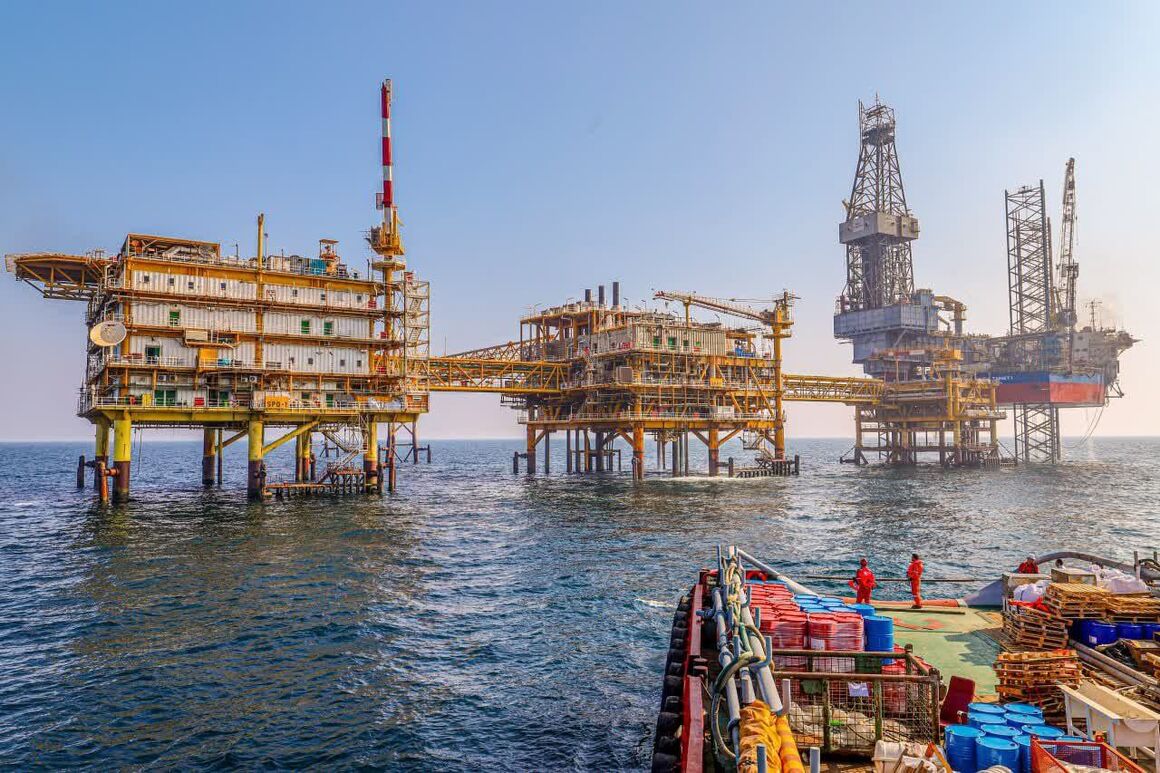
A central pillar of this strategy has been an aggressive overhaul program. In 1404, maintenance operations were completed on 35 offshore platforms within 179 days, involving approximately 160,000 man-hours of labor and more than 16,000 operational work orders.
By comparison, 33 platforms underwent major overhauls in 1403 over a longer period of 207 days. The acceleration of maintenance schedules translated directly into output gains, contributing an estimated additional 1.5 billion cubic meters of rich gas production and delivering the equivalent of 21 million cubic meters per day of extra gas to the national grid.
Alongside faster maintenance cycles, the development of border phases and the drilling of 14 new wells have further strengthened production capacity.
Equipment optimization and operational fine-tuning—often overlooked compared to high-profile expansion projects—have also played a decisive role.
Together, these measures demonstrate that productivity gains are achievable even in mature fields, without necessarily resorting to large-scale new investments.
Reservoir Pressure Decline
The record is particularly significant given the structural challenge facing South Pars. As reservoir pressure naturally declines over time, sustaining output typically requires either compression projects or substantial reinvestment.
That Iran has not only maintained but increased production during this phase highlights the effectiveness of asset management strategies deployed by Pars Oil and Gas Company.
For energy planners, the implications are substantial. South Pars remains the cornerstone of Iran’s gas supply architecture and any decline in its output would have immediate ripple effects across power generation, petrochemical feedstock allocation and industrial continuity.
The new production ceiling offers temporary breathing room for the national gas balance, particularly during peak winter demand.
Strategic Questions
At the same time, the record raises broader strategic questions. Can such levels be sustained as reservoir pressures continue to fall? Will enhanced recovery technologies and compression infrastructure become inevitable in the coming years? And how will financial constraints under sanctions shape future development trajectories?
For now, South Pars stands as a case study in operational resilience. In an environment defined by external restrictions and internal demand pressures, Iran has pushed its flagship gas field to unprecedented output levels—turning efficiency, maintenance discipline, and incremental drilling into a production breakthrough. Whether this represents a temporary surge or a new plateau for the field will become clearer in the winters ahead.