
Hamid Mollazadeh
The declining role of compressed natural gas (CNG) in Iran’s fuel mix has emerged as a growing concern for energy policymakers, particularly as the country grapples with a widening gasoline imbalance.
Once promoted as a strategic alternative to curb gasoline consumption, reduce imports and enhance energy security, CNG is now steadily losing its share—highlighting what experts describe as a “triangle of failure” rooted in weakened economic incentives not only for consumers but also for station operators and the government alike.
Over recent years, gasoline imbalance has evolved into one of Iran’s most pressing energy challenges. Rapid growth in gasoline consumption, combined with insufficient expansion of domestic refining capacity, has pushed the country into a state of chronic gasoline deficit.
As a result, Iran has been forced to rely on multi-billion-dollar gasoline imports annually, placing additional strain on public finances and exposing the fuel supply system to heightened vulnerability—especially under sanctions or during periods of geopolitical or domestic crisis. In this context, diversifying the transport fuel basket is no longer a policy choice but a strategic necessity.
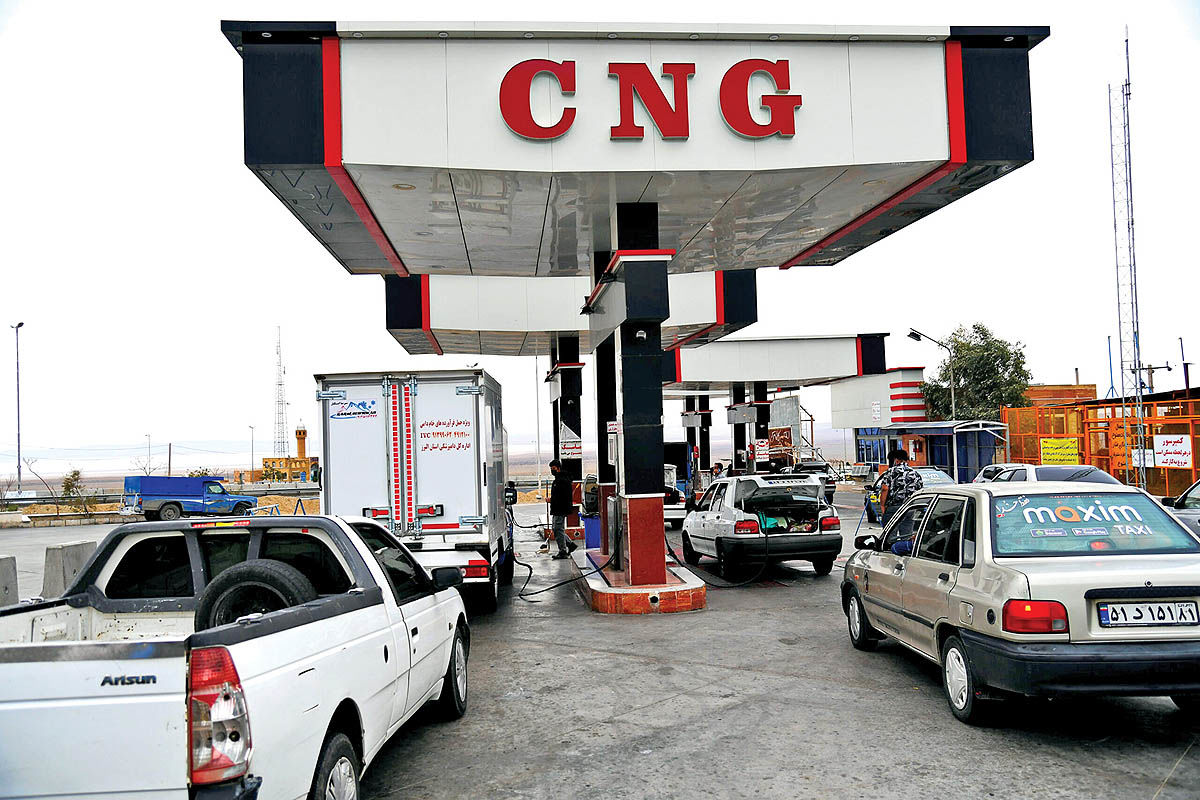
CNG, in theory, should be the cornerstone of this diversification strategy. Iran possesses extensive natural gas resources and over the past two decades, has already invested heavily in building the required infrastructure.
Since 2002, around 2,600 CNG stations have been constructed nationwide, approximately 4.5 million vehicles have been either factory-produced or workshop-converted to dual-fuel capability, and various forms of financial support and credit facilities have been allocated to support the sector. Yet despite these efforts, the outcome has fallen short of expectations.
Iran’s Transport Fuel Mix
At its peak, CNG accounted for more than 20% of Iran’s transport fuel mix. By 2024 (1403 in the Iranian calendar), however, this share had fallen sharply to around 11.5%.
Daily CNG consumption declined to roughly 19 million cubic meters in 2024 and dropped further to about 16 million cubic meters per day in the first half of 2025. This is particularly striking given that existing infrastructure is capable of supporting consumption levels exceeding 35 million cubic meters per day—more than double current usage.
This gap between capacity and actual consumption suggests that the problem is not primarily technical, but structural and economic.
Pricing policy has played a central role. The gasoline price hike at the end of 2019 temporarily boosted demand for CNG, triggering a short-lived surge in vehicle conversions and increasing CNG’s share in the fuel basket.
However, this effect proved unsustainable. Persistent inflation and the gradual erosion of the price differential between gasoline and CNG after 2021 undermined the long-term attractiveness of gas as a cheaper alternative.
Data from recent years reveal a telling paradox: while the number of dual-fuel vehicles continued to rise, CNG consumption declined. This indicates that simply increasing the fleet of CNG-capable vehicles is insufficient to change consumer behavior. Without meaningful economic incentives, motorists increasingly revert to gasoline, even when CNG infrastructure is available.
As a result, removing structural barriers and restoring financial motivation appears far more critical than expanding vehicle numbers alone.
Station Availability
Infrastructure constraints are often cited as another explanation for declining CNG use, but the evidence suggests this factor is secondary.
The ratio of CNG stations per 1,000 dual-fuel vehicles has remained relatively stable at around 0.6 over the past 15 years. This stability implies that, at the national level, station availability has not deteriorated significantly.
While localized shortages—particularly in densely populated provinces such as Tehran—can discourage use due to long waiting times, the nationwide decline in consumption cannot be attributed solely to the lack of stations.
The core challenge lies in the fading economic appeal of CNG. A comparison of fuel costs for a 100-kilometer drive using gasoline versus CNG shows that, even after the 2019 gasoline price increase, the real savings from using CNG in 2024 amounted to between 3,000 and 8,000 tomans (2 cents and 8 cents).
Such modest savings are often insufficient to offset perceived inconveniences, including refueling time, station queues, or concerns about engine performance. This erosion of cost advantage has become the single most important obstacle to increasing CNG’s share in the fuel mix.
Station economics present an equally troubling picture. Although nominal station commissions roughly doubled over the past decade, their real value—adjusted for inflation—has effectively been halved. This has weakened the financial viability of existing stations and made investment in new ones, particularly in major cities, largely uneconomical.
While recent adjustments to commission rates have helped stabilize the sector to some extent, they have not been enough to restore long-term profitability or attract new investors without additional financial incentives.
Mounting Financial Pressure
The burden is also shifting to the government. Since 2022, the commissions paid to station operators have exceeded retail tariffs, forcing the state to cover the difference.
Over the past few years, this policy has imposed a fiscal cost exceeding 4 trillion tomans ($25 billion). If current trends persist without price reform, the government will face mounting financial pressure alongside declining public interest in CNG—an outcome that would inevitably translate into higher gasoline consumption and increased imports.
In this context, many energy analysts argue that leveraging Iran’s existing CNG infrastructure remains the fastest and least costly option to address the gasoline imbalance, especially given limited financial resources for rapid refinery expansion.
However, achieving this requires a shift toward smarter policy design: restoring a meaningful price differential, offering targeted incentives to station operators and aligning consumer costs with broader energy security objectives.
Without such reforms, CNG risks remaining an underutilized asset—one that reflects not the lack of capacity, but a failure to align economics, policy and consumer behavior in a coherent energy strategy.